

Let’s be honest: learning how to curl hair with a straightener can feel like trying to solve a Rubik’s cube while blindfolded. We have all seen the viral TikTok – make videos where a creator effortlessly twists their wrist and reveals perfect, glossy waves, only to try it ourselves and end up with a crimped, jagged mess.
But here is the secret: your flat iron is actually the most versatile tool in your styling tools arsenal. Unlike a curling iron which usually makes one type of curl, a straightener can create everything from loose beachy waves to tight spiral curls and natural-looking waves. It is the ultimate secret weapon for travel and minimalism.
Whether you have fine hair, coarse hair, short hair, or long hair, this comprehensive step-by-step guide will transform you from a hairstyling novice into a pro. Say goodbye to heat damage and hello to voluminous curls.
This post may contain affiliate links. If you click through and make a purchase, I’ll earn a commission, at no additional cost to you. Read my full disclosure here.
If you’re looking for a styler that can both CURL and straighten hair, then check out L’ANGE HAIR Le Duo 360° Airflow Styler – it’s making waves this 2023 (pun intended!)

Choosing Your Weapon: The Right Straightener Matters
Before we touch a strand of hair, we need to talk about hardware. Not all hair straighteners are created equal, and plate size matters.
The Perfect Plate Size
For the best results and maximum versatility, 1-inch plates are the gold standard.
- 1-Inch Plates: The perfect temperature (pun intended) of sizes. It works for short hair, allows for tight curls, and manages long hair efficiently.
- Wider Plates: If you have extremely long, thick hair, wider plates (1.5 inch+) are great for silky straight hair, but they make curling difficult. They create very large, loose waves but struggle with tight definition.
Plate Material: Ceramic vs. Titanium
- Ceramic Plates: The best choice for fine or damaged hair. They ensure even heat distribution of a flat iron, preventing hot spots that singe the hair shaft.
- Titanium: Heats up faster and holds high temperatures. Better for coarse hair that resists curling.
The Prep: The Foundation of Perfect Curls
You cannot cook a gourmet meal with bad ingredients, and you cannot get long-lasting curls without the right prep.
1. Start with Dry Hair
This is non-negotiable. Using a hot tool on damp hair or wet hair boils the water inside the hair cuticle, causing “bubble hair” and permanent breakage. Your hair must be 100% dry. If you are in a rush, use a round brush and blow dryer or a magical quick dry potion (a speeding blow-dry spray) to ensure no moisture remains.
2. Thermal Protection is Key
Heat styling without protection is a one-way ticket to split ends. Apply a high-quality heat protectant spray or thermal protectant spray liberally. Look for heat protectant products that offer hold—this helps the curl set.
3. Boost the Texture
Silky straight hair (especially freshly washed) is slippery. It needs grip. Apply a light mousse before drying or a texturizing spray on dry hair to give the straightener something to grab onto. This is the best way to ensure better hold later.
Temperature Check: The “Goldilocks” Zone
Using the right heat setting is critical. You want enough heat to reshape the bonds, but not enough to melt them.
- Fine/Damaged Hair: 250°F – 300°F. Stick to lower temperatures.
- Normal/Medium Hair: 300°F – 375°F.
- Coarse/Thick Hair: 375°F – 410°F.
Bonus Tip: There is rarely a need to go above 400°F unless you have extremely resistant hair.
If you’re on the market for a new flat iron that can also curl hair, read our guide to best flat iron for curling hair.
The Technique: A Step-by-Step Guide for Beginners
This is the foolproof methods section. We will focus on the “Glide Method,” which creates the classic flat iron curl.
Step 1: Sectioning is Everything
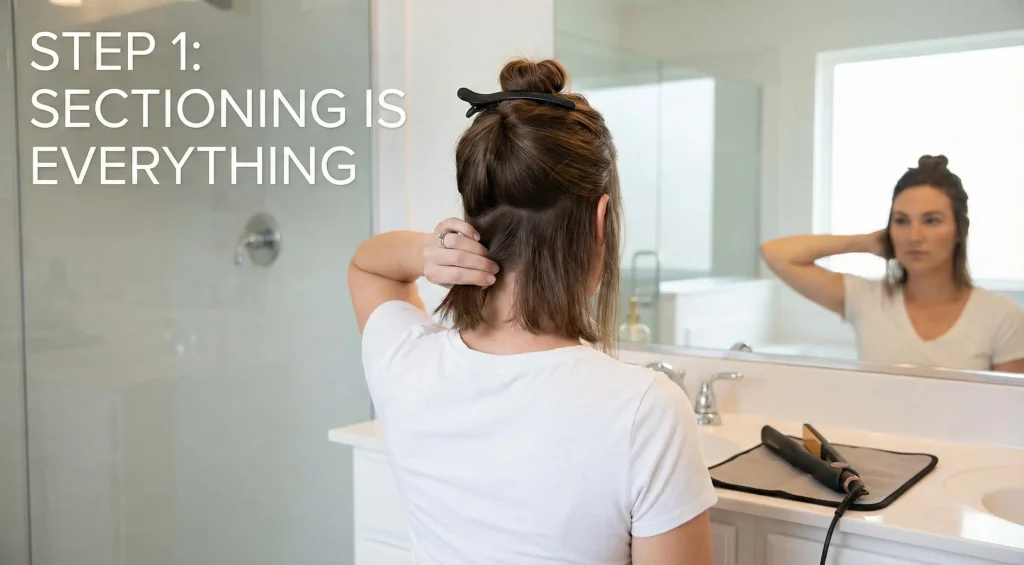
Don’t try to attack your entire head at once. Divide your hair horizontally. Clip the top section away and start with the bottom.
- Pro Tip: Work with smaller sections (about 1 inch wide). Larger sections will result in loose waves that might fall out quickly.
Step 2: The Clamp and Twist
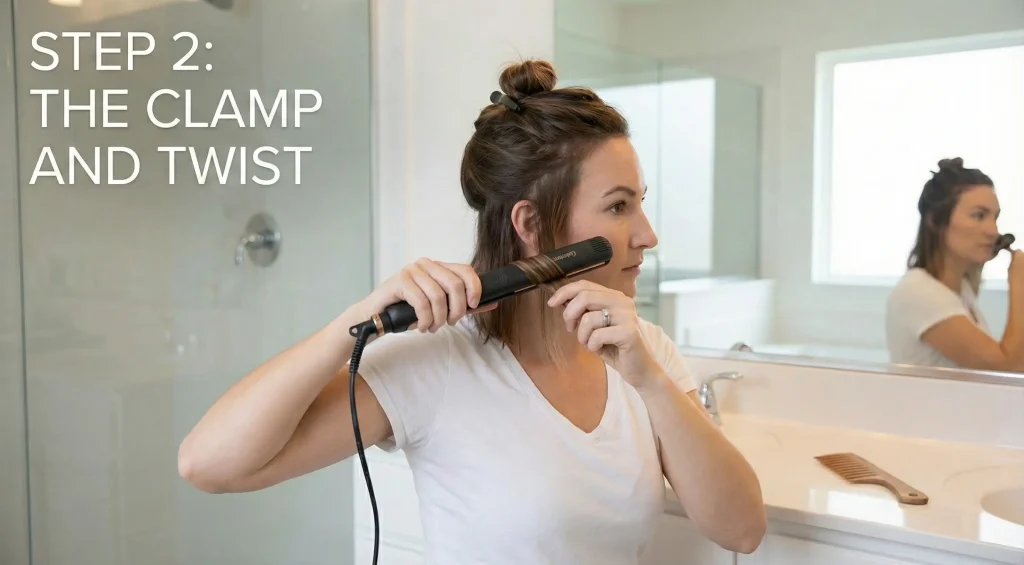
Take a 1-inch section of hair. Comb it with a wide-tooth comb to remove tangles.
- Clamp the straightener near the roots of a small section of hair (but not touching the scalp).
- The Magic Move: Rotate the straightener one half turn (180 degrees) away from your face. The hair should wrap around the body of the iron once.
Step 3: The Glide
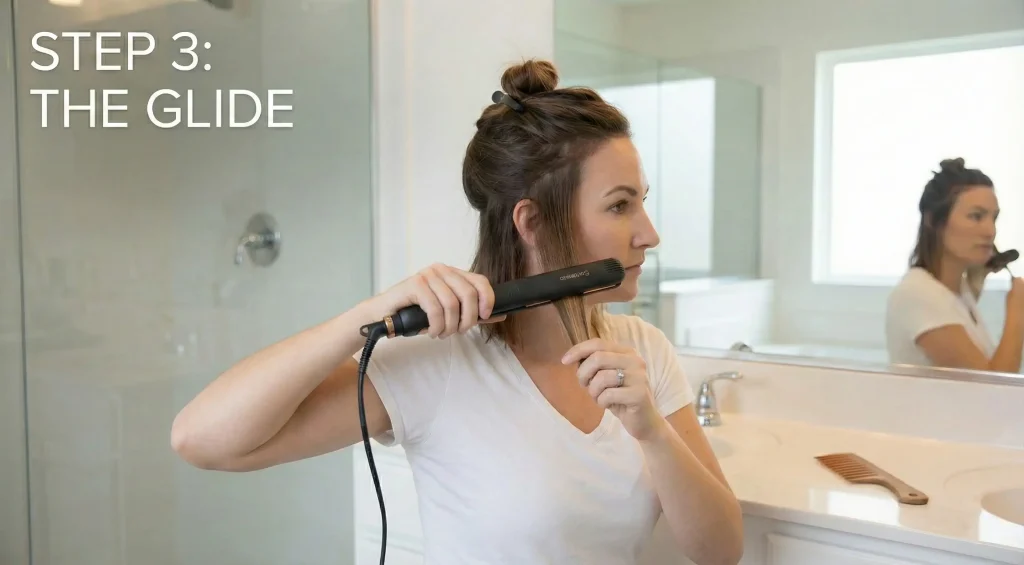
While holding that tension and the rotated angle, slowly pull the straightener down the length of hair.
- Speed Matters: The slower you glide, the tighter the curl. The faster you glide, the looser the wave.
- Tension: Keep the plates closed but don’t squeeze the life out of it.
Step 4: The Cool Down
When the hair releases from the plates, do not touch it. Let the curl cool completely in its spiral shape. This sets the bond.
For a more detailed step by step guide, check out our ultimate guide on how to curl hair with a flat iron!
-
Curl Hair With Straightener: Easy Step By Step Guide
Let’s be honest: learning how to curl hair with a straightener can feel like trying to solve a Rubik’s cube while blindfolded. We have all seen the viral TikTok – make videos where a creator effortlessly twists their wrist and reveals perfect, glossy waves, only to try it ourselves and end up with a crimped,…
Customizing Your Look: Different Ways to Curl
Once you master the basic glide, you can tweak the technique for a variety of curl styles.
1. Effortless Beach Waves (The “S” Bend)
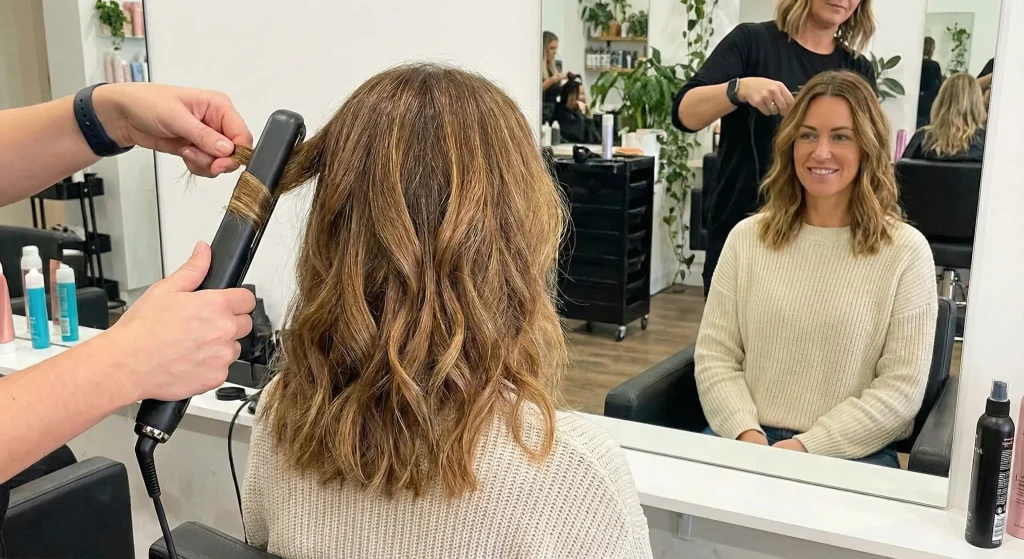
For natural-looking waves that look like you spent a day at the ocean:
- Start the curl at eye level, not the root.
- Leave the last inch of your ends straight (don’t curl them).
- Use larger sections of hair.
- Alternate the direction of the curls: one away from the face, one toward the face. Curling in the opposite direction creates texture and prevents the curls from clumping together into one giant “sausage curl.”
2. Bouncy, Voluminous Curls
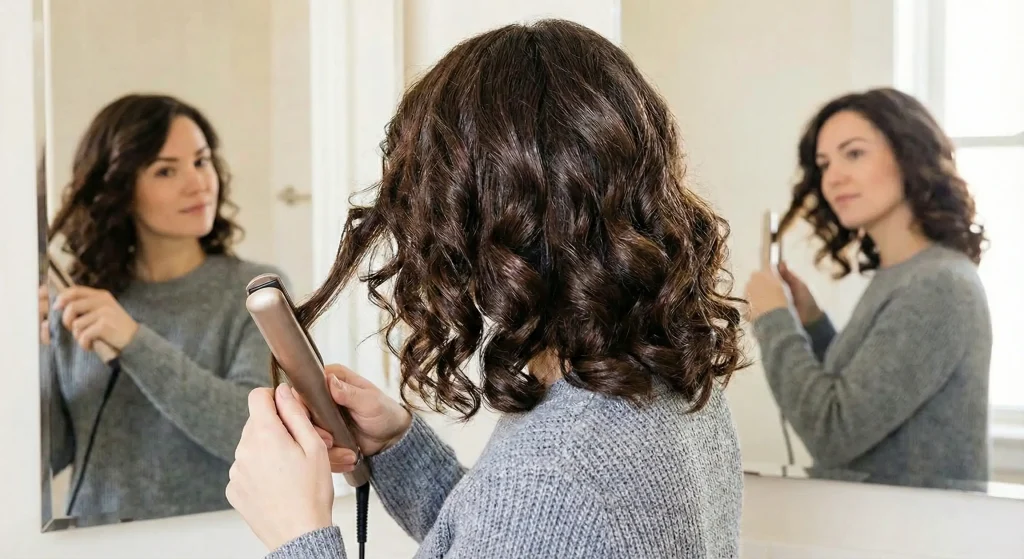
For a glam, red-carpet look:
- Start right at the root for extra volume.
- Rotate the iron a full turn (360 degrees) rather than a half turn creates a ribbon effect.
- Curl everything away from the face for a uniform, polished look.
3. The “New Wave” for Short Hair
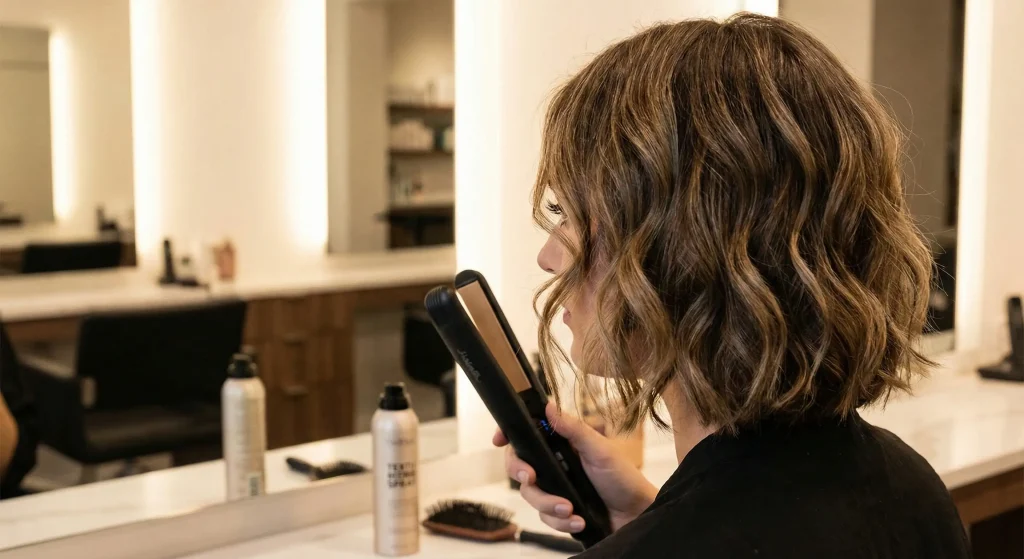
Curling short hair can be tricky.
- Use a straightener with 1-inch plates or smaller.
- Focus on the mid-lengths.
- Twist the iron for a curl, but drag it straight down at the very end to keep the length and avoid the “poodle” look.
Learn More: Different Techniques For Curling Hair With a Flat Iron
Finishing Touches: How to Make Curls Last
You’ve done the work; now make it stick.
- Break the Cast: Once the hair is 100% cool, rake your fingers or a wide-tooth comb through the curls. This transforms tight ringlets into soft waves and expands the volume.
- The Spray:
- For bouncy curls: Use a flexible hold hairspray.
- For fine hair: Use a light-hold hairspray or light hairspray to avoid weighing it down.
- For extra hold: Lift the hair and spray a texturizing spray from underneath.
- Shine: Finish with a drop of serum to tame frizz and create glossy waves.
Troubleshooting: Common Mistakes & Simple Fixes
Even with the best techniques, small mistakes happen.
- Mistake:Horizontal Lines or Dents.
- Fix: You are clamping down too hard before you start moving. Keep the motion fluid. As soon as you clamp, start the twist and glide.
- Mistake:Curls Fall Flat Immediately.
- Fix: You are likely using too much hair in one section, or you are touching the curl while it is hot. Or, you need a higher heat setting for your hair type.
- Mistake:Frizzy Ends.
- Fix: You are gliding too fast, or your plates are not smooth. Ensure you are using ceramic plates or high-quality tourmaline. Also, check if your ends need a trim!
FAQs
Q: Is a flat iron better than a curling iron?
A: Neither is “better,” but the flat iron is more versatile. A curling iron makes round, traditional curls. A best flat iron can create flat iron curl styles, loose beachy waves, and crimped textures. It is the great option for those who want one tool to do it all.
Learn more: Flat Iron vs Curling Iron: Which is better for curling hair?
Q: Why won’t my straightener curl my hair?
A: Usually, it comes down to three things:
- Too much hair: Try smaller sections.
- Wrong technique: Ensure you are doing the full half turn or 360-turn. If you just clamp and pull, you are just straightening it.
- Temperature: Check your temperature calculator. If you have coarse hair, 300°F won’t be enough to change the structure.
Q: How do I curl the back of my head?
A: This is the hardest part! Use a mirror to see the back. Bring the sections of hair forward over your shoulder to curl them. Don’t worry about getting close to the root in the back; mid-length curls look more natural look and blend well.
Q: Can I curl short hair with wide plates?
A: It is very difficult. The width of the plates makes it hard to get close to the scalp without burning yourself. For shorter hair, 1-inch plates or pencil flat irons are the best results generators.
Conclusion
Mastering how to curl hair with a straightener is a rite of passage. It takes practice to get that wrist motion down, but once you do, you unlock a world of easy hair curling hacks and effortless waves.
Remember the golden rules: dry hair only, use heat protectant spray, and let those curls cool! With these best techniques, you are ready to create perfect curls that rival celebrity hairstylists. Grab your straightener and start practicing—your perfect curl pattern is just a glide away.
Image Credits: Deposit Photos